
Why does a 10000mAh power bank only charge a phone once or twice?
Why does a 20000mAh power bank sometimes feel less powerful than expected?
Because of this, many consumers worry about whether a power bank has “fake” or exaggerated capacity.
For brand buyers and importers, real battery capacity is also a major concern when sourcing products. So how can you tell if a power bank is truly overrated, and what counts as normal power loss?
In this article, we’ll break it down in a simple way and help you better understand power bank capacity when sourcing OEM or ODM power banks.
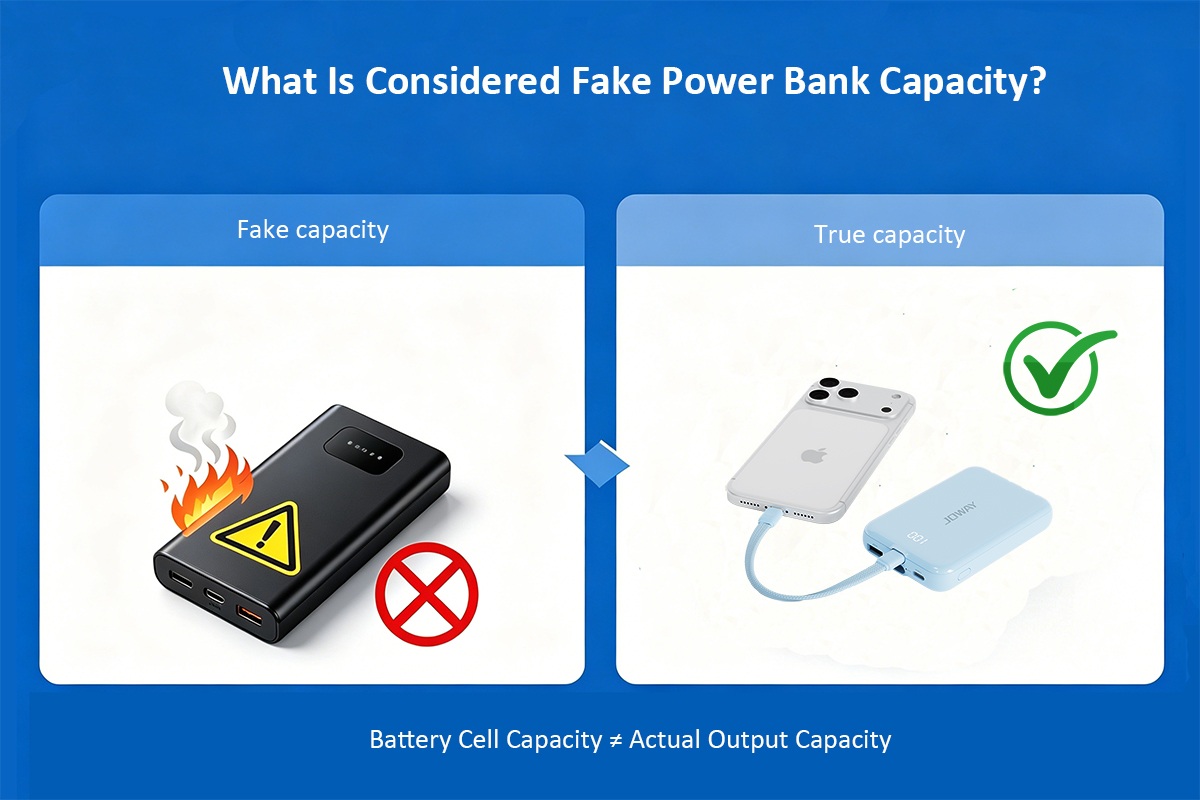
1 What Is Considered Fake Power Bank Capacity?
Many users assume a power bank is fake just because it cannot charge a phone as many times as expected. In reality, that is not always true.
The capacity printed on a power bank usually refers to the internal battery cell capacity, not the actual output capacity delivered to your device.
Real capacity exaggeration usually means:
The actual battery cell capacity is lower than advertised
The rated output capacity does not match the labeled specification
The manufacturer intentionally overstates charging performance or battery life
So when evaluating whether a power bank has fake capacity, you should not only look at how many times it charges a phone. Rated capacity, conversion efficiency, and testing conditions also matter.
2 Why Can’t a 10000mAh Power Bank Output 10000mAh?
2.1 Battery Cell Capacity ≠ Actual Output Capacity
A 10000mAh power bank usually refers to the total battery cell capacity measured at 3.7V.
However, USB output is typically 5V, and fast charging may increase the voltage to 9V, 12V, or higher. This means voltage conversion is required during output.
In theory:10000mAh × 3.7V ÷ 5V ≈ 7400mAh
But this is only the theoretical value. Actual usage also includes circuit loss and energy conversion loss, so the final output capacity is normally lower.
2.2 Voltage Boost Conversion Causes Energy Loss
A power bank must boost voltage from 3.7V to 5V or higher during charging output, and this process naturally creates energy loss.
Part of the energy is released as heat, which means conversion efficiency can never reach 100%.
In most cases:
Power bank conversion efficiency is around 70%–85%
Higher-quality fast charging power banks usually achieve better efficiency
The higher the conversion efficiency, the closer the actual output capacity is to the theoretical value.
2.3 Fast Charging Protocols and Output Power Affect Efficiency
When charging a phone, a power bank communicates through fast charging protocols such as PD, QC, and PPS.
Higher output power generally means:
More heat generation
Higher circuit loss
For high-power fast charging power banks, factors such as: PCB design,Thermal management,Chipset solution,Battery cell quality.
all directly affect conversion efficiency and output stability.
2.4 Charging Cables and Temperature Also Affect Performance
Besides the power bank itself, charging cables and ambient temperature also impact actual charging performance.
For example:
Low-quality cables with higher resistance increase energy loss
High temperatures reduce heat dissipation efficiency
Low temperatures lower battery activity
All of these factors can reduce actual output capacity.
3 What Is Rated Capacity in a Power Bank?
Rated capacity refers to the actual usable output capacity of a power bank under standard testing conditions.
Compared with battery cell capacity, rated capacity gives a more realistic picture of real-world performance.
That’s why, in OEM and ODM power bank sourcing, rated capacity is often more important than the battery cell specification alone.
3.1 What’s the Difference Between Cell Capacity and Rated Capacity?
Battery Cell Capacity:The total internal battery capacity of the power bank, usually measured at 3.7V.
Rated Capacity:The actual usable output capacity under specified output conditions.
For example:
A 10000mAh power bank typically has a rated capacity of around 5500–6500mAh.
3.2 Typical Rated Capacity Range for Different Power Banks
| Battery Cell Capacity(3.7V) | Typical Rated Capacity (5V⎓2A) |
| 5000mAh | 2600–3000mAh |
| 10000mAh | 5500–6000mAh |
| 20000mAh | 11000–12000mAh |
Note: Final rated capacity may vary depending on circuit design, conversion efficiency, fast charging power, battery cell quality, and other factors.
4 How to Check If a Power Bank Has Fake Capacity
4.1 Check the Weight and Size
Power bank capacity is generally related to physical size and weight.
If a product:
Feels unusually light
Is much smaller than expected
Is priced far below the normal market range
you should be cautious about fake capacity or low-quality battery cells.
4.2 Verify Certifications
Reliable power banks usually come with certifications such as:CCC,CE,FCC,RoHS,UN38.3
Different markets require different certifications.
Complete certification information usually means the product has gone through proper testing and is more suitable for branded and cross-border sales.
4.3 Understand the Battery Cell Brand and Quality
Professional power bank manufacturers usually provide clear battery cell sourcing information and perform cell grading tests for consistency.
Battery cell quality directly affects: Actual capacity,Output stability,Cycle life,Product safety…
That’s why battery cell selection is especially important during custom power bank sourcing.
4.4 Test the Actual Output Capacity
One of the most direct methods is using a professional USB power meter to test actual output capacity.
You can also ask the power bank manufacturer to provide:
Capacity test reports
Aging test reports
Shipment inspection data
If necessary, you can request samples for third-party testing.
5 Be Careful With Extremely Cheap Power Banks
Power bank development, manufacturing, testing, and certification all involve real costs.
If the price is significantly below the market average, you should further confirm:
Whether low-quality battery cells are being used
Whether protection circuits have been simplified
Whether testing standards have been reduced
Whether there is a risk of fake capacity claims
For brand buyers, long-term quality and stability are usually more important than the lowest price.
6 How Do Power Bank Manufacturers Ensure Real Capacity?
6.1 Battery Cell Selection and Quality Control
Reliable power bank factories usually choose stable branded battery cells and screen batches for better consistency.
6.2 Battery Cell Capacity Testing
Manufacturers use grading equipment to verify actual battery cell capacity and consistency to ensure stable product performance.
6.3 Aging and Reliability Testing
Processes such as aging tests, high/low temperature tests, and cycle life tests help identify defective products and improve overall reliability.
Final Thoughts
To determine whether a power bank has fake capacity, you need to evaluate multiple factors, including: Battery cell brand,Battery cell capacity,Rated capacity,Conversion efficiency,Testing conditions,Battery quality,Actual test data.
Professional power bank manufacturers usually provide clear rated capacity information along with complete testing and certification documents to avoid misleading customers.
FAQ
Q1. Why Is Rated Capacity Lower Than Battery Cell Capacity?
Because a power bank needs voltage conversion during charging output, and energy loss naturally occurs during the conversion process. As a result, actual output capacity is lower than the battery cell capacity.
Q2. How Many Times Can a 10000mAh Power Bank Charge a Phone?
In most cases, a qualified 10000mAh (3.7V) power bank has an actual rated output of around 6000mAh.
Approximate reference:
Charging a 4500mAh phone: around 1–1.3 times
Charging a 3500mAh phone: around 1.5–1.8 times
Actual performance also depends on factors such as phone battery size, fast charging power, conversion efficiency, and ambient temperature.
Q3. What Is a Normal Power Bank Conversion Efficiency?
In the current market, most power banks have a conversion efficiency of around 70%–85%, although this may vary by product design.
Generally, higher conversion efficiency means output capacity will be closer to the theoretical value.
Q4. Does Fast Charging Increase Energy Loss?
Yes. Under high-power output conditions, fast charging creates more heat and additional energy loss.
That’s why high-quality fast charging power banks require better: PCB design,Cooling structure,Chip control,Power management systems.
to improve overall efficiency and charging stability.