In international trade, power bank customs clearance is a common challenge faced by many brands during the import process. Since power banks contain lithium-ion batteries, power bank shipments are often subject to strict regulations by customs authorities, airlines, and logistics providers during international transportation.
If the product or shipping documents do not comply with the relevant regulations, the shipment may be held by customs, returned, or delayed during customs clearance. This can result in additional storage costs and may also affect the product launch schedule.

1 Why Power Bank Shipments Are Often Inspected by Customs
Since power banks contain lithium batteries, they must comply with strict lithium battery shipping regulations in international logistics. If packaging or handling is improper, there may be potential risks such as overheating or short circuits. For this reason, power banks are considered regulated products in international transportation.
Currently, the major international transport regulations include:
- IATA Dangerous Goods Regulations (DGR) – for air transportation
- IMDG Code (International Maritime Dangerous Goods Code) – for sea transportation
During power bank shipping, shipments typically go through multiple inspection stages, including airlines, freight forwarders, and customs authorities. If the shipment lacks required documents or the declaration information is inaccurate, the goods may be stopped during transportation or customs clearance.

2 Common Reasons Why Power Bank Shipments Are Held by Customs
During power bank transportation, several common issues may cause shipments to be held by customs.
2.1 Missing UN38.3 Test Report
The UN38.3 test report is one of the most important documents for lithium battery transport.
According to the UN Manual of Tests and Criteria, all lithium batteries used in international transportation must pass a series of safety tests and obtain a UN38.3 test report. These tests include:
- Altitude simulation test
- Thermal cycling test
- Vibration test
- Shock test
- External short-circuit test
2.2 Inconsistent Shipping Documentation
Inconsistent or incorrect shipping documents can also lead to customs inspections. Common issues include:
- Product description on the invoice does not match the product label
- Battery specifications do not match the test report
- Incorrect HS code, which may lead to delays in power bank customs clearance or customs inspection
2.3 Incorrect Lithium Battery Labeling
Lithium battery labels must be placed on the outer cartons of power bank shipments.
For power banks with single battery energy above 20Wh or total battery energy above 100Wh, a Class 9 Dangerous Goods label must also be applied to the outer packaging.
2.4 Incorrect Dangerous Goods Declaration
For power banks with single battery energy above 20Wh or total battery energy above 100Wh, the shipment must be transported as dangerous goods.
This requires:
UN-approved dangerous goods packaging
Proper packaging certification
A valid dangerous goods packaging certificate
3 Certifications and Documents Required for Importing Power Banks
3.1 Basic Transport Documents
These documents are typically provided by the power bank manufacturer or the logistics provider:
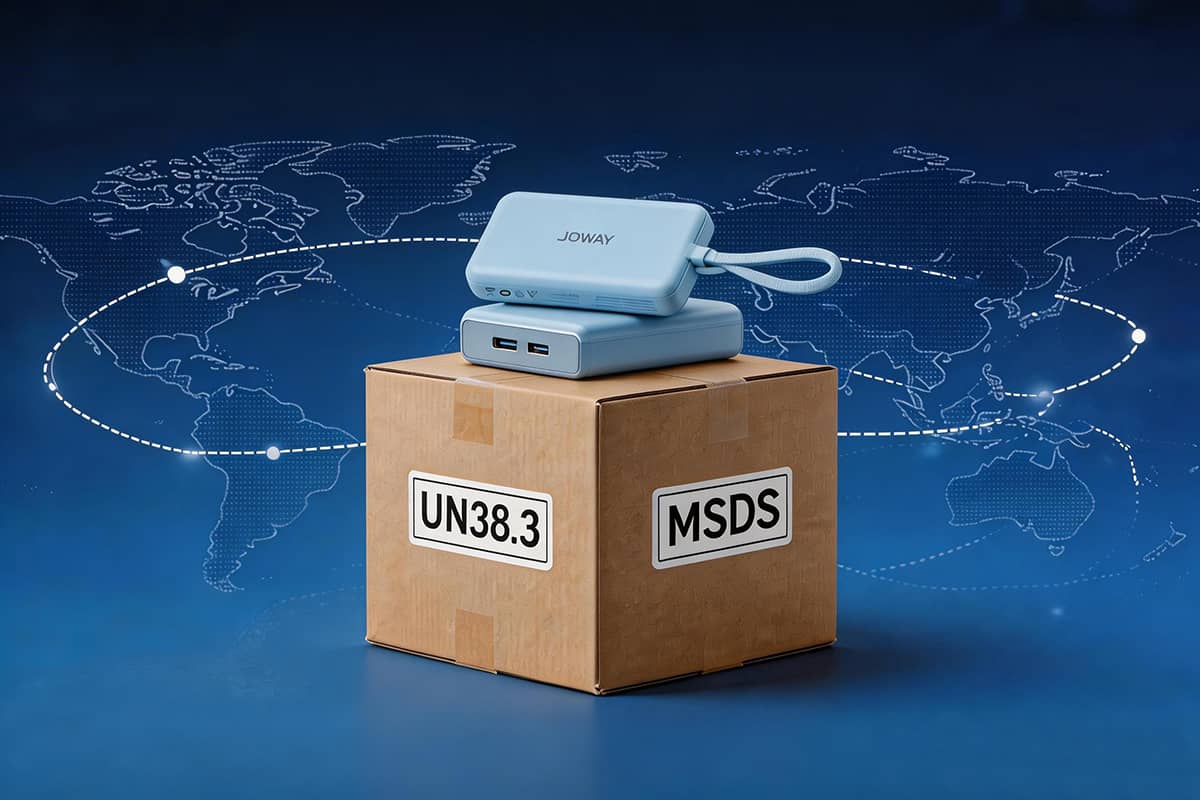
- UN38.3 Test Report
- 1.2m Drop Test Report (for batteries ≤20Wh or battery packs ≤100Wh)
- MSDS (Material Safety Data Sheet)
- Packaging certification and dangerous goods packaging certificate (for batteries >20Wh / >100Wh)
- Destination country customs clearance documents (commercial invoice, packing list, product specifications)
The MSDS document is mainly used in logistics and transportation to describe the chemical properties of the battery and provide guidance for safe handling.
3.2 Market special certification
In addition to the basic compliance documents mentioned above, it is also necessary to meet the certification requirements of the target market.
| Country or region | Special certification | Remarks |
| Europe [importers selling products in the EU also need to assume EPR (Extended Producer Responsibility) obligations))] | CE certification (safety and electromagnetic compatibility) | Mandatory certification |
| RoHS certification | Mandatory instructions | |
| REACH regulations | Compulsory regulations | |
| WEEE Registration (e-waste recycling) | Mandatory instructions | |
| EU battery regulations | New battery method | |
| United States | FCC Certification | Mandatory certification, according to FCC Part 15, wireless charging function needs special attention. |
| UL2056 certification | Market access certification is the mainstream requirement of e-commerce platforms such as Amazon. | |
| DOE/CEC energy efficiency requirements | Mandatory certification is required to meet the energy efficiency requirements of the U.S. Department of Energy (DOE) and the California Energy Board (CEC). | |
| California 65 Proposition Warning Label | Compulsory Warning (California, USA) | |
| Japan | PSE certification | Mandatory certification. Most mobile power supplies belong to the circular PSE category. |
| Korea (certification must be applied by local Korean companies) | KC Certification – | Mandatory certification. According to the standard: KC 62133 (battery safety). |
| EMC certification | Mandatory certification (Korea). The power bank supply needs to be tested for electromagnetic compatibility (EMC) in KC certification. |
It is important to note that power bank certification requirements vary from country to country, and there is no universal certificate that applies to all markets.
Factors such as certification type, certification process, certification timeline, and certification costs should all be taken into consideration when preparing products for international markets.
4 How Professional Power Bank Factories Help Brands Reduce Risks
An experienced ODM/OEM power bank manufacturer can usually provide comprehensive export support for international shipments.
For example, manufacturers can assist with compliance and documentation such as UN38.3 testing, MSDS documentation, dangerous goods transport documents, and market certifications including CE, FCC, and UL.
This support helps brand owners reduce risks during power bank shipping and customs clearance.
5 FAQ
Q1. Do samples also require a UN38.3 test report for transportation?
A: Yes. As long as the product contains lithium batteries, whether it is a bulk shipment or a sample, power bank shipments usually require a UN38.3 test report and an MSDS document during transportation.
Q2. Is sea freight easier than air freight for power bank customs clearance?
A: Not necessarily. Sea freight and air freight focus on different regulatory requirements.
For air transport, regulations are stricter regarding UN38.3 documentation and packaging requirements.
For sea transport, there are stricter requirements for dangerous goods declarations and dangerous goods packaging certificates.
Regardless of the shipping method, incorrect dangerous goods declarations may result in power bank shipments being held by customs.
Q3. Will adding a custom logo affect FCC or CE certification?
A: Simple logo printing usually does not affect certification.
However, if the customization involves changes to the internal structure, battery cell replacement, or modifications to the PCB design, the product must be re-tested for certification.
Q4. Can a power bank manufacturer help complete all certifications?
A: Professional power bank factories can usually assist with UN38.3 testing, provide MSDS documents, support CE/FCC/KC certification applications, and prepare dangerous goods transportation documents.
This greatly reduces the risk of delays during power bank customs clearance.
Overall, power banks are highly regulated products in international trade.
To avoid shipments being held by customs, it is essential to understand lithium battery transport regulations in advance, prepare complete customs clearance documents, and ensure compliance with certification requirements in the target market.